Blake McGrath’s privacy and isolation rule
The light house: A love storyBlake McGrath’s privacy and isolation rule is the strict no-contact boundary surrounding his hidden life: visitors cannot simply telephone him, his location must not be disclosed, and even inscriptions on his paintings must avoid the date on which he is rediscovered. The rule initially protects a man who has withdrawn from public life and grief, but it also creates the secrecy that makes his concealed work vulnerable to exploitation by Duncan Cartwright and ultimately allows Connie Dixon to approach him on terms different from those imposed by the gallery world.
Definition and Operation
Blake McGrath’s rule is first conveyed through Thad Ryan, who warns Connie Dixon that Mr. Mason may not welcome a visitor. When Connie says that she intends to telephone first, Thad stops her with a blunt prohibition: “You can’t do that.” His explanation is equally brief: “No phone.” The absence of a telephone is therefore not an incidental inconvenience but a deliberate barrier, preventing casual contact and forcing anyone who seeks Blake to cross the physical distance to his secluded residence.
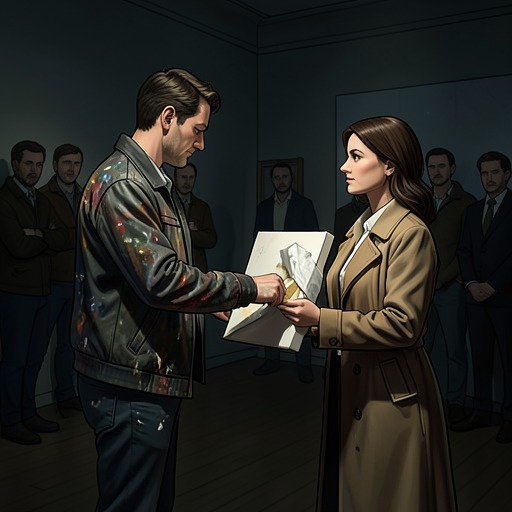
Once Connie has earned access, Blake states the rule himself and extends it beyond communication. After signing the paintings she has bought, he writes a personalized message to “my good friend Connie” but keeps the original dates rather than dating the inscriptions to the day of signing. He explains that a current date would reveal that Connie has found him. The instruction is explicit: “You’re to tell no one where I am, Connie. No one.” Privacy means not merely silence about a name or a past identity, but concealment of the present location that could reconnect Blake to dealers, collectors, journalists, and the commercial art system.
The dated inscriptions show how carefully the rule manages information. Blake wants the paintings to retain their value, and a personal dedication may help that value, but he refuses to let the transaction become a trace leading back to him. The old dates preserve the fiction of lost works while protecting the fact of his survival and whereabouts. Connie promises that she will tell no one, giving her word in a rush of gratitude; for a time, the rule becomes an agreement between them rather than merely Blake’s unilateral command.
Causes and Protective Function
The rule belongs to Blake’s larger retreat from public identity. Duncan Cartwright describes him as America’s most famous contemporary artist, known as America’s Rembrandt, with exhibitions at the Louvre and the National Gallery in London. His last major showing was in New York six or seven years earlier; afterward, it was announced that he had gone away to create new work, but he disappeared from public view. The contrast between international fame and absolute inaccessibility makes privacy part of the mystery of Blake McGrath rather than a minor domestic preference.
His withdrawal is also bound to the ocean, Chloe, and unresolved grief. Ned leaves the room when the clock signals the evening routine and goes to the beach; Blake later explains that he and Ned send a rose into the sea at sunset, while the Great Dane waits on the empty beach until sunrise for Chloe. Blake keeps the lights of the light house on so that Chloe might find her way home. These repeated acts make isolation ritualized: the house, the beach, the dog, and the absent telephone form a closed emotional world organized around waiting for someone who cannot return.
The rule consequently has a double character. It is a boundary against intrusion, but it is also a structure of avoidance. Blake can preserve the rituals that hold his grief in place so long as the outside world cannot easily reach him. When Connie shares the pain of Chloe’s death, however, the isolation begins to loosen. The next morning, while Connie returns to Hoyt Harbor to collect her belongings, Blake dusts Chloe’s bedroom and changes the sheets. The action marks a movement from preserving an untouched memorial space toward cautiously re-entering life, without suggesting that the sorrow has disappeared.
Conflict with Duncan Cartwright
The privacy rule becomes politically and economically important because Duncan Cartwright wants access to whatever Blake’s disappearance has concealed. Duncan knows the scale of Blake’s reputation and the prices attached to his work: the final exhibition contained twenty-four seascapes, with the largest selling for 1.6 million and even the smallest study of shells and rocks fetching several hundred thousand dollars. A hidden location therefore represents not only a private refuge but a potentially enormous market opportunity.
Connie’s secrecy places her between Blake’s need for protection and Duncan’s demand for control. Duncan has already dominated the last four years of Connie’s life, supporting her while making her sell other artists’ work, exploiting her dependence, and using threats concerning her mother’s nursing-home care and Connie’s apartment. His language reduces obligation to ownership: “You owe me for everything I have done for you.” The same coercive logic governs his attempt to discover Blake’s whereabouts. He threatens to cut off the nursing-home money and evict Connie if she refuses to reveal the information.
When Duncan strikes Connie after accusing her of lying, the privacy rule is exposed as a direct challenge to his power. He wants to turn Blake’s hidden paintings into a new exhibition and proposes that he and Connie work together on a Blake McGrath show. Connie rejects the proposal, and she points out that the dedication is dated five years earlier, so it cannot prove that Blake is alive or that she has found him. Duncan’s response is not evidence but violence: he slaps her and insists that he can see the truth in her eyes. The rule thus protects Blake indirectly by giving Connie a secret that Duncan cannot legally or commercially seize, even though he tries to extract it through economic threats and physical assault.
Consequences and Relaxation
For Connie, honoring Blake’s rule initially requires resistance to the entire pattern of disclosure demanded by Duncan. She refuses to identify the location even when threatened, and the old dates on the paintings help preserve uncertainty about when the works were obtained. Her secrecy becomes one of the first concrete acts through which she stops treating Duncan’s demands as binding. The boundary that Blake establishes for self-protection becomes, in Connie’s hands, a resource for reclaiming autonomy.
The rule is not finally abolished so much as transformed. Blake’s isolation has depended on concealment, but his relationship with Connie creates a controlled return to connection. He allows her to possess and exhibit the hidden works, permits her to display his new portrait, and eventually appears publicly at the opening of the Connie Dixon Gallery of Fine Art. At that event he acknowledges that Connie’s love, laughter, passion, and persistence lifted him from despair. He also announces that blindness had seemed to end his artistic career, but that he will return to the easel to paint emotion.
This public return changes the meaning of privacy. Blake no longer needs absolute disappearance as the only defense against grief or exploitation, yet the decision remains his. He chooses when to reveal himself, what to show, and why to paint again; the movement is from enforced public absence to self-directed visibility. The rule has therefore done more than conceal a famous artist. It has preserved the conditions under which Blake could survive long enough to decide whether public art still belonged to him.